
In 2021, I followed Fr. Mike Schmitz (from Ascension Press) in his Bible in a Year (BIY) podcast which read through the Bible chronologically rather than straight through the Bible, book by book. It gave me a fuller understanding of the history of the Old Testament. I found Fr. Mike’s reading and commentary very helpful. When Ascension Press announced they were going to produce the Catechism in a Year (CIY) podcast in 2023 with Fr. Mike I knew it was going to be good. I just didn’t realize how profound the impact would be on my personal prayer life.
I have never read through the Catechism of the Catholic Church (CCC) before but only used it as an authoritative reference. (Usually used to settle a disputed point in a family conversation). The CCC just seemed daunting in length and I have a terrible track record when it comes to reading books to the end. The unfinished stack piled beside my bed is a dusty reminder. The daily CIY format of bite size readings and commentary help me to stay on track and gives me time to mull over each new topic.
One of the early sections caused me to reflect on God’s gentleness and patience, “The divine plan of Revelation …involves a specific divine pedagogy: God communicates himself to man gradually.” CCC 53 Salvation history is all about God slowly revealing himself to humanity. Thus, the way God speaks to the people of the Old Testament reveals something about who God is. That He is One; there is no other god beside Him. That He is creator of everything and that He desires people to know Him and worship Him alone. God invites Abraham and his descendants into a relationship with Him that they might give witness of His greatness and goodness to the rest of the world.
With each successive era, God reveals to mankind how to worship and live with others in justice and peace. Humanity fails with rare exception while God in His patience continues to instruct, admonish and lead people closer to Himself. The culmination of Divine Revelation being Jesus Christ, the Son of God who reveals the heart of His Father to us.
While God has slowly revealed himself through history, he does the same with each of us personally. He gives the grace to each to begin the search for God and then as we respond, He leads and directs us through our life circumstances to come to faith and trust in His great love for us. I am frequently humbled by the patience God has with me particularly when I am not very patient with others.
At the beginning of Lent I had the opportunity to visit the Shroud Encounter exhibit at St. Thomas the Apostle church in Ann Arbor. I first heard of the Shroud of Turin when I was in high school and was fascinated by the image on the cloth. Many Catholics believe the Shroud to be the burial cloth of Jesus. There is a miraculous image of a crucified man with wounds that correspond to the gospel accounts of Jesus’ crucifixion.
The Shroud exhibit walks you through all the archeological evidence and scientific testing, (carbon dating, blood sample tests, pollen samples, etc.) that place the origin of the cloth in first century Palestine. Then the forensic analysis gives the horrific story of the brutality that was savagely meted out to the man of the Shroud. And just when you are trying to wrap your mind around that you get to see a full-scale replica of the shroud up close.
The first time that the shroud was photographed in 1898 the photographer was stunned when he looked at the negative. The face he saw a positive image. (The image on the shroud was a photonegative). As more advanced computer technology has been applied to study the shroud it was discovered that 3-D information is contained in the image as well, allowing for a holographic image to be produced. The hologram is also on display at the exhibit. But what moved me the most was a sculptor’s full-sized corpus of Jesus based on all the information from the shroud. Seeing his face and touching the holes in his hands and feet was unforgettable.
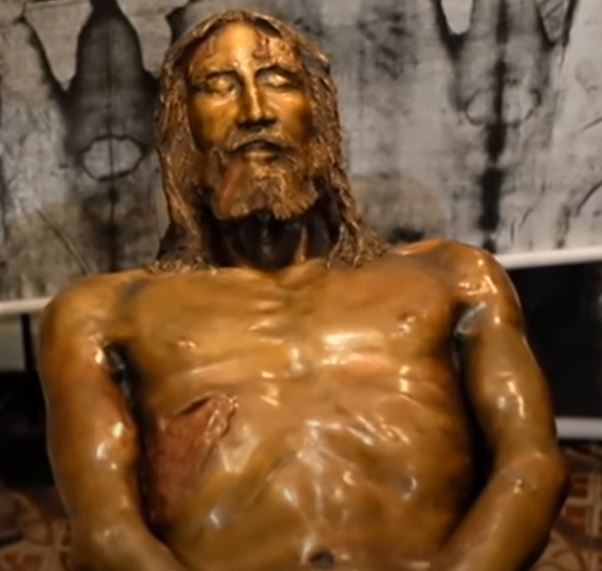
Just before Holy Week the CIY coincidentally was focused on Christ’s redemptive death in God’s plan of salvation. This is beautifully explained in the following paragraphs:
God takes the initiative of universal redeeming love
604 By giving up his own Son for our sins, God manifests that his plan for us is one of benevolent love, prior to any merit on our part: “In this is love, not that we loved God but that he loved us and sent his Son to be the expiation for our sins.” [1 John 4:10; 4:19] God “shows his love for us in that while we were yet sinners Christ died for us.” [Rom 5:8]
605 At the end of the parable of the lost sheep Jesus recalled that God’s love excludes no one: “So it is not the will of your Father who is in heaven that one of these little ones should perish.” [Mt 18:14] He affirms that he came “to give his life as a ransom for many”; this last term is not restrictive, but contrasts the whole of humanity with the unique person of the redeemer who hands himself over to save us. [Mt 20:28; cf. Rom 5:18-19] The Church, following the apostles, teaches that Christ died for all men without exception: “There is not, never has been, and never will be a single human being for whom Christ did not suffer.” [Council of Quiercy (853): DS 624; cf. 2 Cor 5:15; 1 Jn 2:2] (CCC 604 – 605)
Blessed Anne Catherine Emmerich was an Augustinian nun from Westphalia, Germany who lived from 1774 until 1824. She became quite ill and bedridden with great pain and for five years received the stigmata (the wounds of Christ). Throughout her life she had many mystical visions which she recounted to acquaintances who recorded and published them after her death. This year I finally took some time to read portions of The Dolorous Passion of Our Lord Jesus Christ. It is published in book form but it is also available online at this link.
The very detailed descriptions of these visions engage the imagination and fleshes out the scriptural accounts of Jesus’ trial, sufferings, scourging, and crucifixion. Again and again, I was moved by the single-minded determination of Jesus to endure to the end all this so that I might gain eternal life with Him. What a grace it was to take the opportunity to meditate on the Lord’s great act of love for us all.
When I think how my faith has grown from a childish “following the rules” to seeking a personal relationship with Jesus and then to clinging to Him through trials and sufferings, I am becoming more aware of God’s patient pedagogy. Slowly, slowly He initiates, draws us in. As we respond He reveals more of himself to us. He encourages, corrects, challenges, consoles. The Bridegroom woos His bride. Everything He does is for our benefit.
 You Are Loved