Remember you are dust and to dust you shall return.
“Remember you are dust and to dust you shall return.” These are the words proclaimed on Ash Wednesday as ashes are applied to the forehead in the shape of a cross. Initially addressed to Adam in Genesis 3:19 after the fall, they call us to remember that one day we will die and all our plans will come to nothing. This mortal body will return to the earth.
Something deep within us wants to shout a resounding, “NO!!” We inherently know that there is more to the self than the physical body. The soul, that which animates the body, expresses itself in speech, actions, and the will. It rebels at the idea of death since the human soul is an immortal spirit, which can not die, it remains after death when the soul leaves the body.
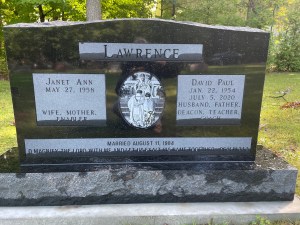
I have been present at the deaths of four people; my father-in-law, my mother-in-law, my three-year-old niece, and my husband. It is a holy experience when the one dying is in right relationship with God. It is also gut-wrenching to say good-bye to those you love so intimately.
I have read many accounts of near-death experiences. Individuals describe the moment of death as an out-of-body experience as they rise above their bodies and are able to see and hear those around them. For this reason, I spent time with my husband’s body. I told him how much I loved him. When the paramedics left, they draped his body with a white cloth. They left the IV in his arm and a plastic airway tube in his mouth. We removed them. I wanted to see his face and be present to this body that had been a temple of the Holy Spirit.
In the Christian understanding of death, man dies as a result of his fallen nature. “All have sinned and fallen short of the glory of God.” (Romans 3:23) But the story doesn’t end there. Out of God’s infinite love for mankind and his desire to have a relationship with him, Jesus comes to earth on a rescue mission. God condescends to take on a human body and then takes upon himself the penalty of sin – death itself. “O death, where is thy sting? O grave, where is thy victory. . . But thanks be to God, which gives us the victory through our Lord Jesus Christ.” (1 Cor 15:55-57)
Not only does Jesus take our punishment upon himself, but in his resurrection “this mortal nature must put on immortality.” (1 Cor 15:53) Our bodies, also, will one day rise again. Psalm 116:16 reminds us that, “Precious in the eyes of the Lord is the death of his faithful ones.” You are dust and to dust you shall return, precious, precious dust.
It seems that lately, death has touched nearly everyone; death from Covid, miscarriages, the passing of the elderly, and also sudden death in those who are young and apparently in good health. It seems like a daily encounter, constantly in the news. Death leaves us with a heavy heart. How do we deal with it without succumbing to despair?
First, don’t try to ignore it. Acknowledge the loss, pain, and fear. Often difficult questions consume our thoughts. Why did this happen? Where was God when I prayed? Why did they have to suffer? What is the meaning of my suffering? This hurts so much it can’t be for nothing.
Second, take your anguish to God in prayer. Take some time in silence and listen to Him. What is He trying to say to you? “The Lord is near to the broken hearted, and saves the crushed in spirit.” (Psalm 34:18). The death of a loved one is often a “wake up call.” God calling us back to himself. One man I know who lost his infant son to SIDS (Sudden Infant Death Syndrome) came back to a full active Catholic faith because he was desperate to see his son again. More than anything, God desires to have a relationship with His children. Turn to Him in your grief.
Third, respond to the Lord. Are you seeking comfort? Spend time in prayer. Let the Holy Spirit, the Comforter bring you peace. Are you concerned for the salvation of the deceased? Pray for the repose of their soul. Thank the Lord for the relationship that you had with your love one. Recall the good memories and the blessings in your life and thank Him.
When we face death, either our own or someone near to us, we are drawn to reflect on our life’s direction. Where are we going? What are we doing? What is our purpose in life? Have we just wasted our time here on earth? Will anyone even remember me when I am gone? What is my legacy? If my life has been focused on getting ahead, making money to buy that next latest gadget or build a bigger, better home, to whom will all that piled up wealth go when I die? You can’t take it with you.
“For the wise, like the fool, will not be long remembered;
the days have already come when both have been forgotten.
How the wise man dies just like the fool! . . . I hated all the things I had toiled
for under the sun, because I must leave them to the one who comes after me.
And who knows whether that person will be wise or foolish?” (Ecclesiastes 2:16-19)
What will be your legacy? What remains? What can you actually take with you? A hero is remembered for acts of heroism. A saint is remembered for acts of piety and deep prayer life. A martyr is remembered for the witness to the faith to the point of giving up their own life.
What about us? What can we do? For most people we live our daily lives with our families. If we take our faith seriously and make every effort to train our children in it, we pray that we may one day see the fruit of our labors join us in heaven. Be a good mom. Be a good dad. Whatever your vocation, choose to be good. Ask the Lord for help. “And I tell you, Ask, and it will be given you; seek, and you will find; knock, and it will be opened to you. For every one who asks receives, and he who seeks finds, and to him who knocks it will be opened. . . . If you then, who are evil, know how to give good gifts to your children, how much more will the heavenly Father give the Holy Spirit to those who ask him!” (Luke 11:9-10, 13)
As we near the end of this Lenten season and approach Holy Week we are presented with a great opportunity to reflect on the covert rescue mission Jesus executed for our sake. The holy and almighty God takes our mortal nature, is subjected to brutal humiliation and takes the penalty of our sin upon himself. So concerned is He for our welfare that He intercedes for us to God, the Father. Even on the cross He made excuses for our sin, “Father, forgive them, they don’t know what they are doing.” (Luke 23:34).
This meditation on the Passion of Christ by Saint Leo the Great, Pope from Thursday Office of Readings for the Fourth Week of Lent brings to focus the victory that Christ won for us.
Contemplating the Lord’s Passion
True reverence for the Lord’s passion means fixing the eyes of our heart on Jesus crucified and recognizing in him our own humanity.
The earth—our earthly nature—should tremble at the suffering of its Redeemer. The rocks—the hearts of unbelievers—should burst asunder. The dead, imprisoned in the tombs of their mortality, should come forth, the massive stones now ripped apart. Foreshadowings of the future resurrection should appear in the holy city, the Church of God: what is to happen to our bodies should now take place in our hearts.
No one, however weak, is denied a share in the victory of the cross. No one is beyond the help of the prayer of Christ. His prayer brought benefit to the multitude that raged against him. How much more does it bring to those who turn to him in repentance.
Ignorance has been destroyed; obstinacy has been overcome. The sacred blood of Christ has quenched the flaming sword that barred access to the tree of life. The age-old night of sin has given place to the true light.
The Christian people are invited to share the riches of paradise. All who have been reborn have the way open before them to return to their native land, from which they had been exiled. Unless indeed they close off for themselves the path that could be opened before the faith of a thief.
The business of this life should not preoccupy us with its anxiety and pride, so that we no longer strive with all the love of our heart to be like our Redeemer, and to follow his example. Everything that he did or suffered was for our salvation: he wanted his body to share the goodness of its head.
First of all, in taking our human nature while remaining God, so that the Word became man, he left no member of the human race, the unbeliever excepted, without a share in his mercy. Who does not share a common nature with Christ if he has welcomed Christ, who took our nature, and is reborn in the Spirit through whom Christ was conceived?
Again, who cannot recognize in Christ his own infirmities? Who would not recognize that Christ’s eating and sleeping, his sadness and his shedding of tears of love are marks of the nature of a slave?
It was this nature of a slave that had to be healed of its ancient wounds and cleansed of the defilement of sin. For that reason, the only-begotten Son of God became also the son of man. He was to have both the reality of a human nature and the fullness of the godhead.
The body that lay lifeless in the tomb is ours. The body that rose again on the third day is ours. The body that ascended above all the heights of heaven to the right hand of the Father’s glory is ours. If then we walk in the way of his commandments, and are not ashamed to acknowledge the price he paid for our salvation in a lowly body, we too are to rise to share his glory. The promise he made will be fulfilled in the sight of all: Whoever acknowledges me before men, I too will acknowledge him before my Father who is in heaven.
The Ash Wednesday proclamation – “You are dust and to dust you shall return,” reminds us of our lowly nature. Holy week reminds us of the amazing love the Triune God has for these lowly creatures made of dust. Easter brings us hope beyond hope, that our mortal bodies, this very precious dust, can be raised to eternal life with the Father.
 You Are Loved
Very well stated, Janet. Thank you for reminding us of what really matters. I especially like the phrase “covert rescue mission” and the inclusion of the quote from Pope St. Leo the Great. It makes me think of the Resurrection Homily of St. John Chrysostom, which we will proclaim in a couple of weeks. Glory to Jesus Christ!
LikeLiked by 1 person